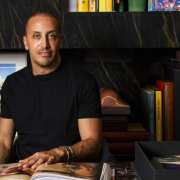

How many conversations does it take before you stop hearing anecdotes and start hearing patterns? Somewhere past the hundredth meeting I stopped counting cities and started counting themes. By the five hundredth, the themes had hardened into a single question - the one that sat underneath every other question, in every city, in every language, over every table.
Nobody asked it in those words. It arrived sideways, in what people wanted to talk about before they would talk about anything else: the deal that went wrong, the adviser who served himself first, the platform that promised connection and delivered spam. I came prepared to discuss structures and allocations. What families wanted to establish first was whether I was someone they could be in a room with.
This is easy to mistake for caution, or for slowness. It is neither. It follows from something structural about how family capital works.
Capital is not scarce. Anyone who has sat with the family groups of Riyadh, Singapore, Monterrey or Zurich knows the money is there - patient, substantial, largely unencumbered. What is scarce is the confidence to deploy it alongside someone else. The industry talks about deal flow. Families talk about who brought them the deal. Those are not the same conversation, and the gap between them is where most of this business happens.
It follows, too, from the horizon families are working on. When you are choosing a counterparty for a transaction, you need to know they will perform. When you are choosing one for decades - through a succession, a downturn, a change of leadership on both sides - you need to know something much harder to establish, and no amount of documentation will establish it for you.
Which brings me to the third part of the question, and the part I have no clean answer to. Who is a matter of judgement, and families are good at it. With what is a matter of structure, and the good ones are careful. But how do I know is a genuinely open problem. Reputation travels badly across borders. References are given by people with an interest in giving them. The families I met have solved it, largely, by only doing business with people they or their friends have known for twenty years - which works, and which also explains why so much capital sits next to so few opportunities.
Everything I am building is an attempt to answer that third part. I do not think technology replaces trust; I think it can carry it further than a personal network reaches. Whether that is true is the thing I will spend the next few years finding out.
.png)

